
Scout Network: YouShape: Your Network, Your Say
Network is run by its members, for its members — youth shaped by design.
Ages 18–25 District Scout Network Member-led project teams Free, no adult learning required No YouShape Award — by design
Scout Network is planned and delivered differently from every other section. It is run by its members, for its members — so there is nothing for adults to hand over, because it was never theirs. That makes Network the only section where youth shaped Scouting is the default rather than the goal.
Image
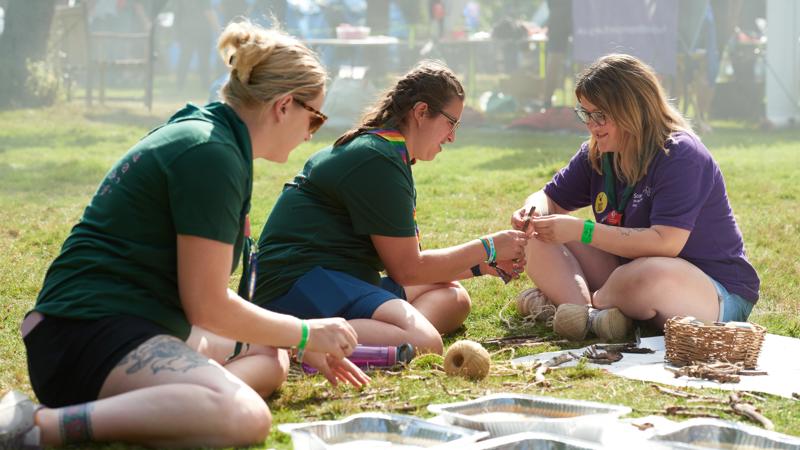
Which is exactly why it goes wrong in a particular way. In the younger sections the risk is that adults hold on to too much. In Network the risk is the opposite: everyone assumes someone else is organising it, and nothing happens for a year.
There is no YouShape Award for Network
This is a design decision, not an oversight. The YouShape Award exists to prove that young people shaped a programme that adults would otherwise have written. In Network there is no such programme to shape — members create it, organise it and run it, managing their own journey with support from their District team. A badge for shaping your own programme would be a badge for turning up.
What that means in practice
- No requirements to meet and no volunteer to sign them off
- The programme is whatever members decide to make happen
- Nobody is going to notice if you do nothing — there is no badge chart to look empty
- Recognition comes through the top awards instead, which are considerably harder
So what replaces it?
Three things: the top awards, which are the real recognition route for 18 to 25s; real roles in Districts, Counties and Trustee Boards; and the habit of saying out loud what people have done.
The rest of this page is about all three.
Try this next meeting
Ask the question the award would have asked
The central YouShape badge asks a young person what they want to get out of Scouts and how they will make it happen. Ask your Network exactly that, individually, once a year. It takes ten minutes each and it is the single most useful thing a Network Team Leader can do.
How Network actually works
Worth stating plainly, because a lot of volunteers in the younger sections have never been told any of this — and a lot of Explorers turn 18 and quietly disappear because nobody explained it to them either.
Membership is automatic
Every District has a District Scout Network by rule, and all 18 to 25 year olds involved in Scouting are members of it. Take an appointment in another District and you become a member of that Network too.
Not tied to a District if you do not want to be
Anyone can be part of the UK Scout Network instead, with the same access to opportunities. Useful for members away at university or working unpredictable hours.
Project teams, not weekly meetings
Some Networks meet a few times a year to deliver one project. Others run several at once. Flexible and self-led is the model, not a compromise.
Who supports it
Your District Scout Network Team Leader first. If there is not one, your District 14-24 Team Leader, then your District Lead Volunteer. County volunteers support Network across the County, and there is a UK Lead for Scout Network.
At university?
Check whether there is a Student Scout and Guide Organisation (SSAGO) club. It sits alongside Network membership rather than replacing it.
Recognition without a YouShape Award: the top awards
Image

Network members can work towards a set of awards that are more demanding than anything in the younger sections. These are the recognition route, and they are worth promoting properly — most Network members do not know how many of them are open to them.
King’s Scout Award
The pinnacle. Start at 16 or older, complete before your 25th birthday, and be a member of Explorers or Network (or both) for at least 18 months. Includes service to an individual or the community, and a four-day, three-night self-led expedition with an aim, after training and a practice.
Worth knowing: Awards approved by UK Headquarters are celebrated the following year at Windsor Castle, on the Sunday nearest St George’s Day.
Requirements on scouts.org.uk →
Explorer Belt
A ten-day expedition in another country, built around understanding its people and way of life. Open to Explorers aged 16 and over and to Network members.
Worth knowing: The one most Network members describe afterwards as the best thing they did in Scouting.
Scouts of the World Award
Global development in practice — a discovery phase followed by a voluntary service project on peace, environment or development.
Worth knowing: Pairs naturally with international projects your Network is already planning.
Chief Scout’s Diamond Award
The top award of the Explorer section, which many people finish during their first year in Network.
Worth knowing: If someone joined Network with it unfinished, help them finish it. It is a common near-miss.
Duke of Edinburgh’s Gold Award
Run alongside Scouting and shares requirements with the King’s Scout Award, so the work counts twice.
Worth knowing: Worth planning the two together from the start rather than discovering the overlap late.
The one to watch
The King’s Scout Award must be completed before the 25th birthday, and needs 18 months of Explorer or Network membership. Someone who starts thinking about it at 24 has left it too late. Raise it with members at 18, not at 23.
Two hats: member and volunteer
Network members are the only people in Scouting who are simultaneously a youth section and a pool of adult volunteers. That is a strength and a source of confusion in equal measure.
They are still a section
Network members have their own programme, their own awards and their own right to a say. A Network that only exists as a rota of helpers for other sections is not a Network.
And they are the volunteer pipeline
Youth Leads, section volunteers, trustees, activity permit holders, County team members. Nowhere else in the movement is the gap between being consulted and being in charge so small.
Roles worth naming out loud
- District or County Youth Lead — several South London Districts have a vacancy
- Trustee on a Group, District or County Board
- Section volunteer, Young Leader support, or activity permit holder
- UK Rep Pool, and international events for 18 to 25s
What a Youth Lead actually does
Keep the hats separate
If someone is at a Network meeting as a member, they are not on duty. Being 18 does not mean every event becomes work, and treating Network purely as staffing is the quickest way to empty it.
The 18 gap
More people leave Scouting at 18 than at any other age, and it is rarely a decision — it is a drift. Explorers finish, nobody says what happens next, and six months later they are gone.
What Explorer teams should do
- Encorage them to take part in Next Stop:18
- Tell every Explorer, well before their 18th birthday, that Network membership is automatic and free
- Introduce them to an actual Network member, not a leaflet
- Check whether their Chief Scout’s Diamond or King’s Scout Award is unfinished
- Make the options concrete: keep going as a member, take a role, or both
What Network should do
- Invite the outgoing Explorers to one thing that is actually happening
- Ask them what would make it worth their time, then do some of it
- Do not lead with a rota
Explorers who shaped their own Unit programme are far more likely to expect the same at 18 — and to stay when they find it. Youth shaped Explorers
Plan, Lead, Represent in Network
Every South London YouShape page uses the same three words. There is no badge for them in Network — which makes them more useful as a self-assessment. If a Network cannot point to all three, it is a social group with a Scouts logo on it.
Plan is thinking creatively, working together and planning activities. Lead is supporting others, delivering the programme and stepping up on nights away. Represent is telling others about it and speaking up for the group.
Plan
- Run the Network committee and set the programme
- Plan and deliver an event for the wider County
- Manage the budget and the bookings yourself
Lead
- Lead a project, an expedition or a County event
- Volunteer as a section or District Youth Lead
- Support the Young Leaders' Scheme in your District
Represent
- Stand as a District or County Youth Lead
- Sit on a Trustee Board as a trustee, not an observer
- Speak for young people at County, national and international level
YouShape in one night
A working Network meeting that ends with names against projects rather than a list of ideas nobody owns. It uses activity cards from this site, so you can print the night and run it as it stands. Download this session plan (PDF)
Quick Fire YouShape
Ask who wants the Youth Lead role
Most Districts are short of a Youth Lead. Name the vacancy at your next Network meeting and describe what the role actually involves. Someone in the room will be interested. Find your Youth Lead
Run one youth forum for a younger section
Offer a District section a Network-run youth forum. You get delivery experience, they get an outside facilitator, and the young people get taken seriously.
More activities are at the bottom of this page.
Closing the loop with Network
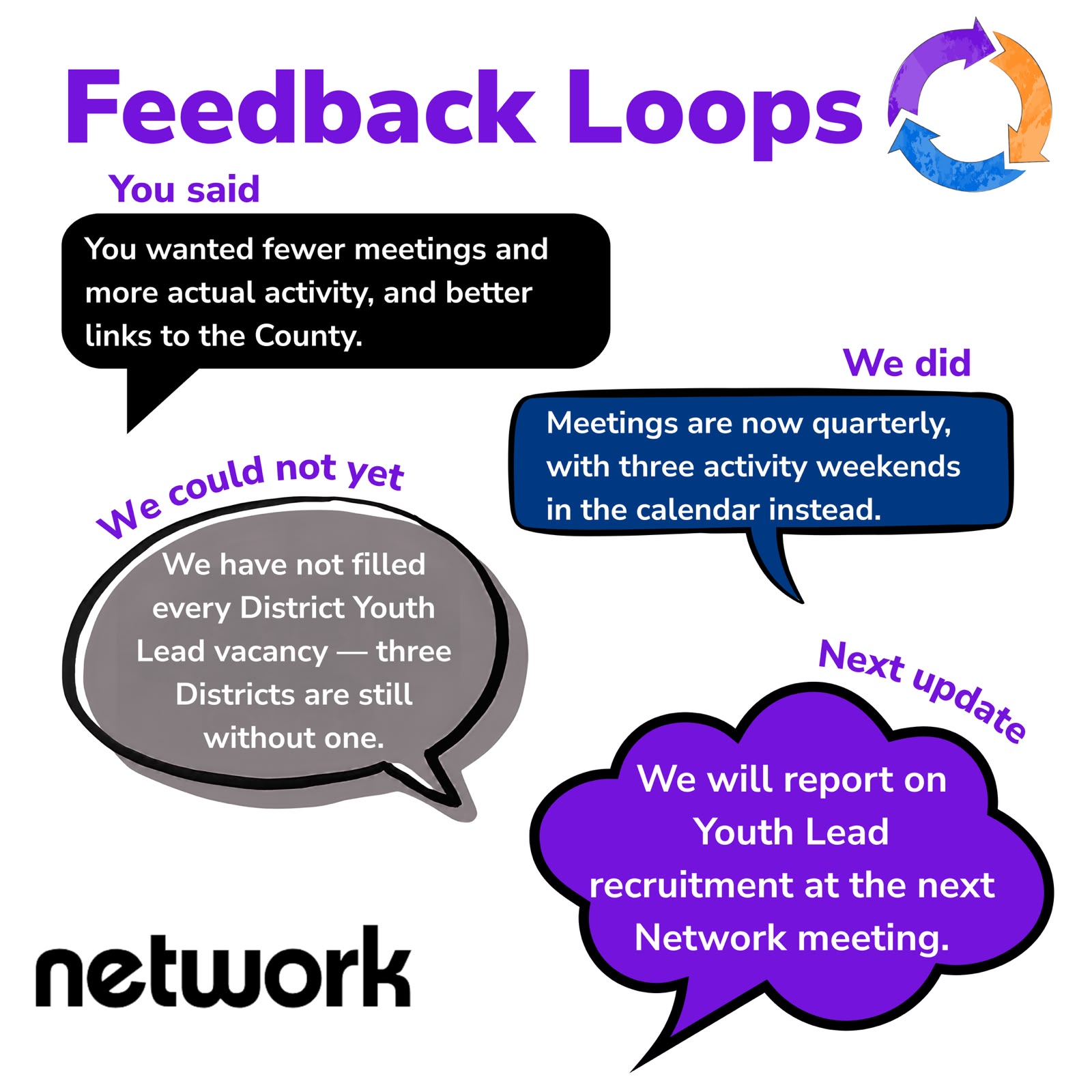
Member-led does not mean nobody reports back. If your Network has asked its members what they want, or fed views up to the District or County, the same four lines apply — and adults at District and County owe Network the same honesty they owe a Cub Pack.
Image
The people who deliver the strategy locally
Network members are able to sit on Trustee Boards and organise events. Nowhere else in the movement is the gap between being consulted and being in charge so small.
How this relates to the strategy
We attract and retain more volunteers by making the experience inclusive and rewarding, and by equipping them to contribute in flexible, fulfilling ways. How Network youth shaped Scouting delivers the strategy