First Response Training
Image
Keeping young people safe is our primary aim in Scouts. Having fun, taking part in adventurous activities, and experiencing new things comes a close second.
One of the ways we do this is to ensure that a qualified first aider is present during our activities.
To meet this the minimum first aid training required by everyone that has regular contact with young people (and helps delivery the programme), is First Response learning. This training has to be refresh every three years. (You do not need to be first aid trained before you become a leader in a section.)
You can find out the roles required to complete first aid training by checking the Appointments: Table 2 in POR.
You can complete any of the course we provide (that's First Response, Emergency First Aid at Work PLUS, or First Response blended learning). Higher levels of qualification are needed if delivering first aid training or leading certain kinds of activities in remote environments.
First Response covers the skills and knowledge necessary to enable our teams to manage an incident and provide basic first aid. Our national First Response programme of learning has been developed in collaboration with Girlguiding, with a common syllabus, resources and acceptance between the two organisations.
Our First Aid learning comprises of two training elements:
- Module 10A - First Aid theory which covers the first aid theory
- Module 10B - First Aid practical which is a short 20-30 minute session covering assessment of a casualty and CPR. You will also have the opportunity to discuss with the trainer anything you are unsure about.
In order to be registered as ‘compliant’ you must complete both parts of this training. Your completion date will be the date that you completed module 10A.
All groups undertaking activities in remote environments (as defined in POR) must have immediate access to someone holding a relevant and current full first aid certificate.
Our county offers an annual programme of opportunities to complete first aid learning.
Objectives, content and duration
We offer the opportunity to attend two types of first aid certificate. Both our First Response and Emergency First Aid at Work courses follow the same 6 hours of learning.
Both courses:
- Provide you with simple first aid information which is relevant to your role
- Help to build confidence and skills in coping with emergency and first aid situations
- Equip you with the knowledge needed to manage these emergencies
Both courses focus on four main areas:
- Life support: The principles of first aid and initial response (arriving and managing an incident), emergency life support, CPR (including technique for children and an explanation of what AED is and how to use it), management of an unconscious casualty (child and adult), and choking.
- Trauma and injury: Shock, bleeding, fractures (ambulance imminent and non-imminent) and sprains, head injuries, dental incidents, and burns.
- Major illnesses: Asthma, anaphylaxis, heart attack, stroke, seizures, diabetes, sepsis and meningitis.
- Reporting Incidents, Illness and Emergencies: local accident book, local records, when to report to UK HQ, near miss reporting, reporting to external agencies, regulatory serious incident reporting, what happens next, learning from the incident, future planning for safety.
Why do we have two different courses that cover the same syllabus?
Some of our County First Aid Trainers are reregistered as First Aid Trainers with Walker Training Services, this enables them to run the Emergency First Aid at Work course.
The Emergency First Aid at Work course syllabus doesn't cover all the requirements of our minimum learning (Frist Response). These being:
- Life support: child CPR.
- Trauma and injury: dental incidents.
- Major illnesses: diabetes, sepsis and meningitis.
- Reporting Incidents, Illness and Emergencies: local accident book, local records, when to report to UK HQ, near miss reporting, reporting to external agencies, regulatory serious incident reporting, what happens next, learning from the incident, future planning for safety.
In order to meet the minimum requirements these topics are also covered during the course meaning that the same course syllabus is delivered on both courses.
This makes the Emergency First Aid at Work course an Emergency First Aid at Work PLUS course!
if you have any questions about this please email first.aid@southlondonscouts,org,uk
Alternative external first aid training & First Response online conversion course
Anyone who wishes to use an external first aid course to validate First Response Training must show a fully accredited First Response Trainer that they have met or can meet all the requirements of our First Response syllabus.
This includes knowledge of child related illnesses and the demonstration of child CPR, which are commonly not included on external courses. This is to make sure that all volunteers who are carrying out first aid have the skills to manage incidents relating to children and young people.
Any course that is set by a reputable body, and covers the above criteria, recognition, and length requirements outlined above can be considered as a suitable alternative to a full First Response first aid certificate. Examples of reputable bodies include: St John Ambulance, The British Red Cross, British Canoeing, Mountain Training, etc.
Please note: The Scouts do not accept online only qualifications.
If a member's qualification does not fully meet the First Response content (for example, a First Aid at Work certificate), a First Response Trainer must support the learner in completing any missing elements. by referring to the Course Comparison sheet.
Depending on the gaps identified, a member may be able to use either the First Response Conversion Course or the First Response e-Learning to support evidencing gaps in knowledge, including child-related illnesses.
The Conversion Course covers dental incidents, sepsis / meningitis, chest pain / heart attacks and strokes and should be used for those who have minimal gaps in learning such as those who have completed a First Aid at Work, Paediatric First Aid or Outdoor First Aid course.
If the learner has more gaps in their learning, for example after having completed an Emergency First Aid at Work course, they should complete the First Response e-Learning instead.
Learners will need to enrol on either of these courses to be able to complete it. The courses can be found on My Learning by using the ‘Explore Learning’ tab and search for ‘First Response e-learning' or 'First Response conversion course’
Completing the course will award a skill and Learning Assessors can see these skills on a volunteer’s record in the same way they can view any skills.
The learner may also need to demonstrate, or instruct another adult, in CPR face-to-face with a First Response trainer. Please note that you will not be able to act as the designated first aid cover a section events or activities until this has been done. Click here to book your place at a practical demonstration and validation ONLY session.
Professions with first aid experience
The Scouts recognises that some professions by the nature of the job will have a first aid element; for example, Nurses, Midwives, Police Officers, Medical Practitioners, Members of HM Armed Forces, Ambulance Care – Assistants/Paramedics/Technicians, etc. to exempt these professions from undergoing more first aid training, they are required to provide evidence of an up-to-date qualification which should meet the criteria for what is considered our minimum standard (as listed above). With regards to ‘evidence’, this can be a certificate or an official letter confirming the necessary areas have been met.
By completing the relevant course above you will be able to validate Module 10A and 10B (as per the date on your first aid certificate).
Course booking fee (non-refundable / non-transferrable)
Places on our first response courses are in very high demand and sadly, we regularly have people that book onto our learning and cancel their place at the last minute or just do not turn-up. This means that someone who is waiting to complete the training could of taken part.
To help manage the demand for places on our first response courses and in the hope of running full sessions we have a £12.00 per person non-refundable / non-transferrable booking fee to attend our First Response courses. From January 2025 this will also roll out to our Emergency First Aid at Work courses.
This fee is non-refundable and cannot be transferred to another course. If you are unable to take part in the course you book on to you you will need to pay the fee again when you book on another course.
To avoid this we suggest that if you find you are unable to attend you offer your place to someone that needs to complete their learning.
Catering & refreshments
- We provide tea and coffee throughout the day.
- You will need to bring your own packed lunch.
Care, respect and integrity: our scouting values
A lot of time goes into planning our learning opportunities to make them happen. Please only book onto this learning if you absolutely intend to block the time out of your schedule and honour your commitment to attend.
We know things can happen, so if you find you are really unable to attend this session, please let us know, by emailing [email protected], as soon as you can, and at least 24 hours before (T&Cs apply).
First aider badge
There is no badge available for the completion of the First Response or our Emergency First Aid at Work 6 hours courses.
Volunteers with an in date first aid qualification (16 hours course, also known as full first aid course) can wear a first aider badge on the left sleeve, as shown on the uniform diagram. This can either be the badge provided by the first aid training provider or the Scouts first aider badge available from Scout Store. Only one badge may be worn.
Certificate Renewal
Following a review of First Response training, The Scout Association no longer offers a refresher course option. All volunteers must therefore complete the full six hours of training to renew the First Response certificate.
For delivery of adventurous activities
Any course (minimum 16 hours) that is set by a regulated body, may be considered suitable for delivering first aid in remote adventurous activities. Consideration must be made to the suitability, environment and skills provided through this qualification and the relevance to the activity and environment being undertaken.
If this qualification is also being used for the volunteers' First Response learning requirements, then see the above section on validating First Response.
Image
How do I complete my training?
We provide a number of opportunities to complete your First Aid training.
In person learning (face-to-face 6 hour course)
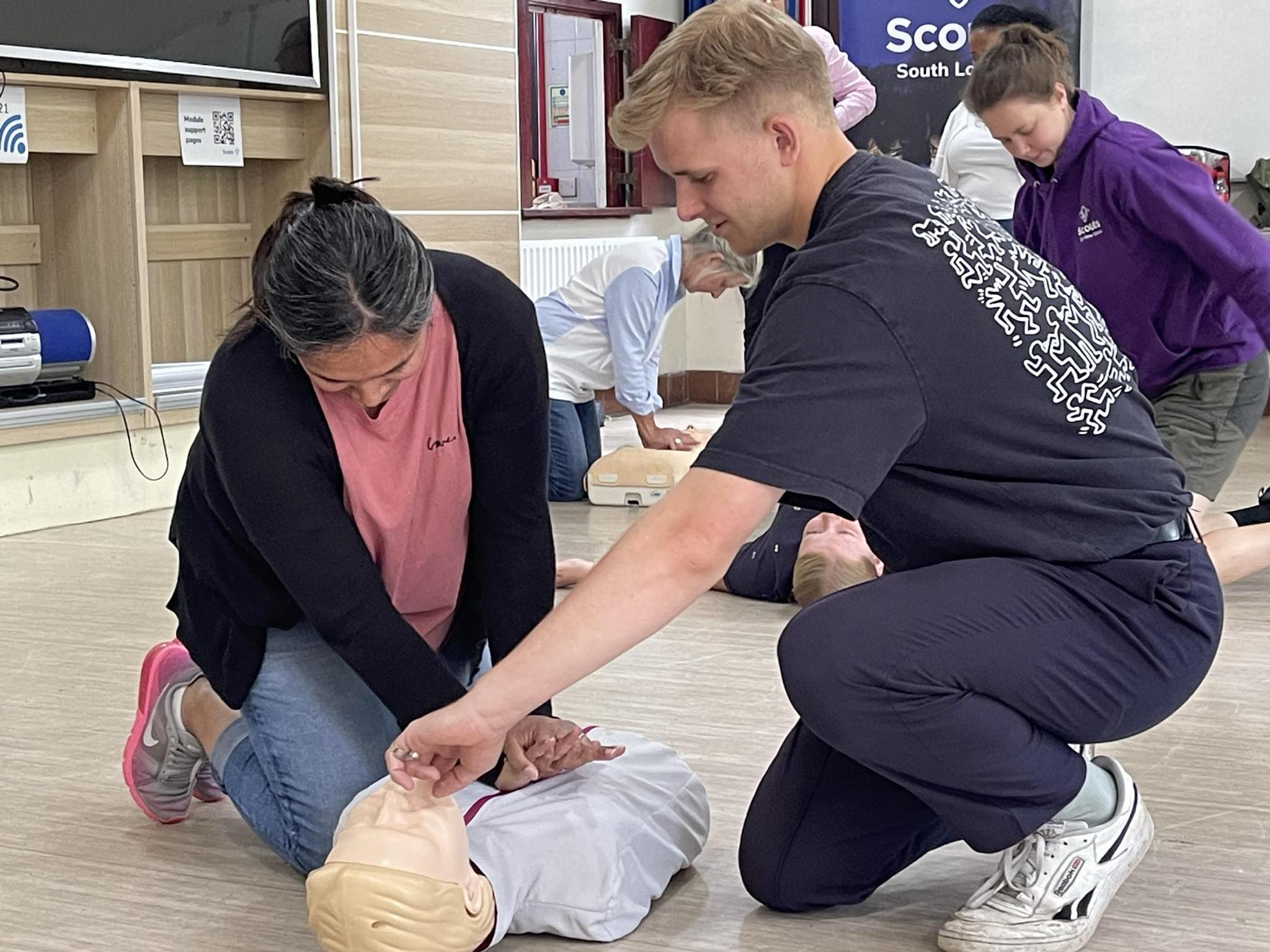
In person training is held at local various scout venues around the county. It contains both the theory (10A) and practical (10B) modules. The Training takes six-hour to complete.
We offer the opportunity to gain a Scouts issued First Response certificate or an Emergency First Aid at Work certificate. Both certificates follow the same syllabus.
The certificate we provide after completing First Response training is designed specifically for adults in The Scouts and Girluiding, based on the situations and issues that occur within these organisations. It is not, therefore, externally recognised.
Emergency First Aid at Work certificate courses are usually limited to 12 participants per course.
First Response certificate courses are usually limited to 24 participants per course.
You can book a place on one of our 6-hour course by clicking on the in-person button below.
Blended learning (a mixture of online & in person)
This method of learning is available for First Response learning only.
Blended learning combines a 2½ hour eLearning session with a 3 hour online session for the theory part of the training (10A). The practical validation (10B) is a short (12-30mins) face-to-face session, which covers the practical elements of the life support training.
The e-learning is provided online through My Learning and must be completed first.
You can only attend the 10B practical validation once you have completed both part the eLearning and online sessions. You must attend this practical session withing 2 months of completing both parts of the 10A learning.
To book on a blended model (three sessions) course - elearning and online delivered by Hampshire Scouts, and delivered by our County First Aid Team click on the blended button below.
How to get started
It’s simple! Click on your chosen learning method and then follow the instructions…
Image

Image

Image